

Sage X3 is Sage's enterprise-class ERP, purpose-built for mid-to-large manufacturers and distributors that have outgrown general-purpose accounting software and need real control over production, supply chain and multi-region finance. This review covers modules, pricing realities, how X3 compares with SAP Business One, Oracle NetSuite and Microsoft Dynamics 365, and exactly which companies should (and shouldn't) be on the shortlist.
In the US mid-market ERP landscape, the same names keep coming up: NetSuite, SAP Business One, Microsoft Dynamics 365 Business Central, Epicor Kinetic, and Sage X3 (now increasingly branded as Sage Enterprise Management and, in some regions, folded under the Sage Business Cloud X3 umbrella). Each product has a clear sweet spot, and Sage X3's sweet spot is manufacturing and distribution companies with 100–1,000 employees, multiple sites, and process or discrete production needs.
This review is intentionally balanced. Sage X3 is a strong product, but it's not a fit for light-industry firms, not a fit for pure services companies, and not a fit for businesses that want a quick 90-day implementation. Where it genuinely leads the category — and where it doesn't — we'll call out both.
Bottom line up front: Sage X3 is a best-fit ERP for mid-market manufacturers and distributors with complex production, multi-site operations, or multi-country requirements. It delivers deep manufacturing features, flexible multi-legislation finance, and strong customization — but implementations are 6–12 months, pricing is typically $180K–$800K+ all-in for year one, and you absolutely need a qualified implementation partner. If those fit your profile, X3 deserves a place on the shortlist next to NetSuite and SAP Business One.
What is Sage X3?
Sage X3 is a full enterprise resource planning (ERP) suite covering finance, supply chain, manufacturing, sales, inventory, and customer service. It runs as either a cloud-hosted deployment (Sage manages infrastructure) or a partner-hosted/on-premises deployment (you or your partner manages it). The underlying architecture is web-based, so end users access X3 through a browser — no desktop install needed — but the data model, customization framework, and extensibility are designed for serious enterprise use, not quick SaaS onboarding.
Sage acquired the product (originally called Adonix X3) in 2005, and it's been Sage's flagship enterprise product ever since. It's used today by thousands of companies across manufacturing, distribution, chemicals, food and beverage, consumer packaged goods, pharmaceuticals, and industrial services — particularly in Europe, Africa, and North America.

Core modules in Sage X3
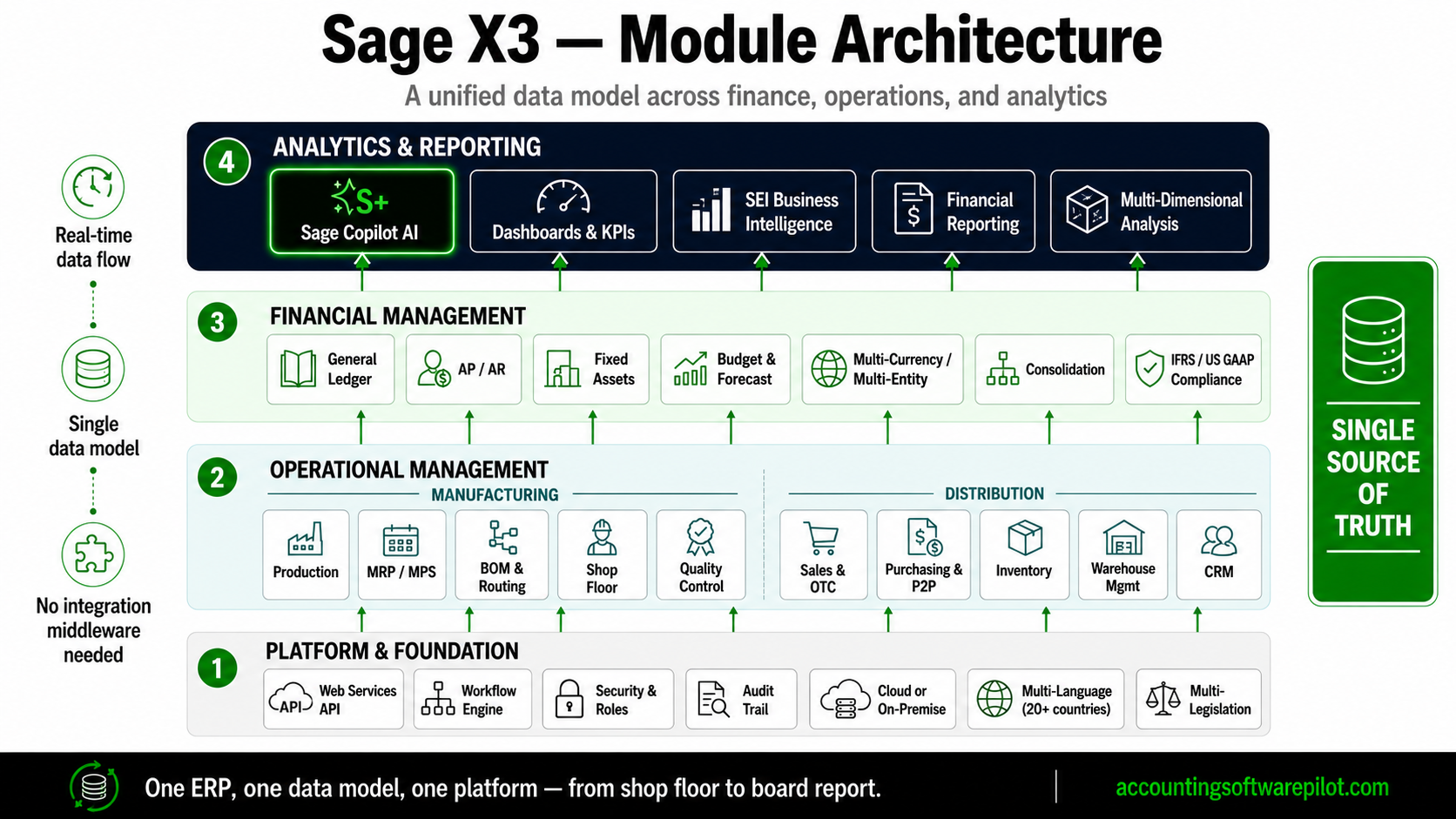
One of X3's defining characteristics is that the core modules are built on a single data model. Finance, supply chain, production, sales and services share the same ledger, the same item master, the same customer/vendor records — eliminating the integration tax that comes with multi-product suites.
Module | What it covers | Notable capability |
|---|---|---|
Financial Management | General ledger, AP, AR, fixed assets, budgeting, tax, multi-ledger accounting | Multi-legislation support (US GAAP + local statutory in parallel), ~40 country localizations |
Supply Chain Management | Purchasing, inventory, warehouse management, sales order management | Multi-site, multi-warehouse, lot/serial traceability, expiration dating |
Production Management | Discrete and process manufacturing, MRP, shop floor, bills of materials, routings | Handles mixed-mode (discrete + process) — rare in mid-market ERP |
Sales Management | Quotes, orders, pricing, contracts, commissions, intercompany sales | Multi-level pricing and rebate management |
Customer Service | Service requests, warranties, contracts, field service lite | Integrated with sales and manufacturing warranty data |
Project Management (light) | Project costing, budgets, revenue recognition, time tracking | Best for internal and mixed project work; dedicated PSA firms may prefer specialty tools |
HR (optional add-on) | Core HR records, time and attendance | Often replaced by Sage HRMS, Workday, or local payroll provider |
Manufacturing: where Sage X3 genuinely leads
If we had to pick one reason customers choose X3 over NetSuite or Business Central, it's manufacturing depth. X3 handles four production modes — discrete, process, batch, and mixed-mode — in a single installation. Few mid-market ERPs do all four well without bolt-on modules from third parties.
Formulas and recipes: Real process manufacturing support with percentage-based formulas, potency, concentration tracking, and byproduct/co-product handling — critical for chemicals, food and beverage, and pharmaceuticals.
Lot and serial traceability: Full forward and backward traceability, required for FDA, FSMA, and pharmaceutical regulations.
Quality management: Built-in quality control with sample plans, specifications, non-conformance handling and COAs (certificates of analysis).
MRP and DRP: Net-requirements calculation across multiple sites with demand forecasting and distribution planning.
Shop floor control: Real-time tracking of work orders, labor, materials and machine utilization.
Version control for BOMs: Engineering change orders (ECOs) with approval workflows.
Where X3 fits best: Process manufacturers (food, beverage, nutraceuticals, cosmetics, chemicals, pharma), mixed-mode manufacturers (companies doing both discrete assembly and process blending), and distributors with complex warehouse and traceability requirements.
Multi-region, multi-legislation finance
X3's second standout capability is multi-entity, multi-country finance. The product supports roughly 40 country localizations out of the box, allowing a US-headquartered company with operations in Mexico, Canada, the UK or the EU to run consolidated finance in a single X3 instance while still meeting local statutory requirements.
Parallel ledgers: Maintain US GAAP and local statutory ledgers simultaneously
Multi-currency: Unlimited currencies with automatic revaluation
Intercompany: Automated intercompany transactions, eliminations and consolidations
Tax engines: Country-specific VAT/GST/sales tax handling, e-invoicing compliance in regulated jurisdictions
Audit trails: SOX-ready internal controls, segregation of duties, and approval workflows
Sage X3 vs the mid-market ERP competition
Most US mid-market buyers will shortlist X3 against SAP Business One, NetSuite, and Dynamics 365 Business Central. Here is how they compare on the dimensions that matter.
Factor | Sage X3 | SAP Business One | Oracle NetSuite | MS Dynamics 365 BC |
|---|---|---|---|---|
Deployment | Cloud or on-prem | Cloud or on-prem | Cloud only | Cloud or on-prem |
Target size | 100–1,000 employees | 10–500 employees | 20–2,000 employees | 10–500 employees |
Manufacturing depth | Excellent (discrete + process) | Good (discrete focus) | Good (discrete; process via add-on) | Good (discrete focus) |
Multi-country | Excellent (40+ countries) | Strong | Strong | Strong (MS OneVersion) |
Customization flexibility | High (4GL and open APIs) | High | Moderate (SuiteScript) | High (AL/Power Platform) |
Time to implement | 6–12 months | 4–9 months | 3–6 months | 4–8 months |
Typical Year 1 total cost (100 users) | $250K–$600K | $180K–$450K | $350K–$800K | $200K–$500K |
Best-fit industry | Process/mixed manufacturing, distribution | Discrete manufacturing, wholesale | Services, e-commerce, software | Distribution, discrete mfg, services |
NetSuite wins on speed-to-value and for services/software/e-commerce businesses. Business Central wins for Microsoft-centric shops with simpler manufacturing. SAP Business One is strong for discrete manufacturers who want a recognized SAP brand without the cost of full SAP S/4HANA. Sage X3 wins when the center of gravity is process or mixed-mode manufacturing, multi-country finance complexity, or both.
Pricing reality for Sage X3
Sage X3 is not a public-price product. Licensing is quoted by a Sage reseller or partner based on number of concurrent users, number of entities, modules activated, and deployment model. Ranges below are based on publicly reported 2024–2025 US implementations and should be treated as directional.
Cost component | Typical range (USD) |
|---|---|
Subscription license (per user/year, cloud) | $2,400–$4,800 per named user |
Implementation services (partner-led) | $150K–$500K+ depending on scope |
Infrastructure (if partner-hosted or on-prem) | $30K–$120K year one |
Annual maintenance/support (on-prem model) | 18–22% of license |
Typical year-one all-in (50–100 users) | $250K–$800K |
Pro tip: When evaluating X3 pricing, insist on a five-year total cost of ownership model — not just year-one. The implementation cost is front-loaded, but the ongoing subscription and optimization costs dominate years 2–5. Compare it apples-to-apples against NetSuite (which is higher in subscription but lower in implementation) and Business Central (lower in subscription but with add-on costs for manufacturing).
Implementation: what to expect
Sage X3 is not a self-implementable product. Every real X3 deployment involves a certified Sage Business Partner, and partner quality varies meaningfully. Typical implementation phases:
Discovery and design (4–8 weeks): Business process mapping, gap analysis, data conversion planning, statement of work.
Configuration (8–16 weeks): Chart of accounts, organizational structure, workflows, user roles, customizations.
Data migration (4–8 weeks, parallel with config): Master data cleanup, open balance loading, historical data decisions.
Integration (4–12 weeks): EDI, CRM, e-commerce, payroll, shipping and any bespoke connectors.
Testing (4–8 weeks): Unit, integration, user acceptance and parallel testing.
Training and go-live (4–6 weeks): Super-user and end-user training, cutover planning, hypercare.
Plan for 6–12 months end to end for a company of 100–500 employees. Rushed implementations are where most X3 horror stories come from — not the product itself.
Note on partners: Your implementation partner matters as much as the product. Ask for references from companies of similar size in your industry, verify the partner has its own certified developers (not just functional consultants), and confirm they've done at least three X3 go-lives in the last 24 months.
Strengths and weaknesses
Strengths
Process and mixed-mode manufacturing: Class-leading in the mid-market ERP segment.
Multi-legislation finance: Parallel ledgers and country localizations make it a natural choice for US companies with international operations.
Customization depth: The 4GL development layer and open APIs allow deep tailoring without forking the core product.
Single data model: Finance, supply chain, and manufacturing share one schema — no integration tax.
Deployment flexibility: Cloud, partner-hosted, or on-prem are all supported — useful when pure cloud isn't an option.
Weaknesses
UI feels less polished than NetSuite or Dynamics 365 Business Central; training investment is higher.
Longer implementation timelines than NetSuite's SuiteSuccess rapid-deploy methodology.
Smaller US ecosystem than SAP or Microsoft — fewer independent consultants and ISV add-ons.
Weaker native CRM and e-commerce — most customers pair X3 with Salesforce, HubSpot or Shopify.
Not a fit below ~$20M revenue — the implementation cost is hard to justify.
Who should choose Sage X3?
Sage X3 is the right ERP if you are:
A mid-market manufacturer ($20M–$500M revenue) in food and beverage, chemicals, pharma, cosmetics, nutraceuticals, or any process industry
A mixed-mode manufacturer running both discrete assembly and process blending in the same operation
A distribution business with multiple warehouses, complex pricing, and lot/serial traceability needs
A US-headquartered business with operations in 3+ countries needing multi-legislation finance
An enterprise outgrowing QuickBooks Enterprise, NetSuite, or a legacy ERP and needing deeper manufacturing control
Look elsewhere if you are:
A services, software, or e-commerce company — NetSuite or Business Central will fit better
A pure discrete manufacturer under 100 employees — Business Central, SAP B1, or Epicor Kinetic will be cheaper and faster
A company that needs a deployment live in under six months — X3 implementations are longer
A business that wants an AICPA-preferred, pure-cloud financial suite without heavy manufacturing — Sage Intacct is likely the better Sage product for you
Sage X3 vs Sage Intacct: which Sage product fits?
This comes up often inside the Sage portfolio itself. Intacct is a cloud financial management suite (GL, AP, AR, revenue recognition, multi-entity consolidation, project accounting); X3 is a full ERP with deep manufacturing and supply chain.
Scenario | Better fit |
|---|---|
Services firm, SaaS, agency, nonprofit — finance-first | Sage Intacct |
Multi-entity consolidation, revenue recognition, AICPA-preferred | Sage Intacct |
Manufacturing with BOMs, routings, shop floor, MRP | Sage X3 |
Distribution with multi-warehouse, lot tracking, EDI | Sage X3 |
Multi-country finance with statutory ledgers | Sage X3 |
Pure US, cloud-only, under 50 employees | Sage Intacct |
Final verdict
Sage X3 is a serious enterprise ERP that's a clear shortlist candidate for mid-market manufacturers and distributors, especially those with process manufacturing or multi-country operations. It's not cheap, it's not fast to implement, and it's not a fit below the $20M revenue mark — but for the right buyer, it delivers capabilities that general-purpose cloud ERPs simply don't match.
Overall: Sage X3 is the strongest mid-market ERP choice for process and mixed-mode manufacturers, multi-site distributors, and US-headquartered companies with meaningful international operations. Shortlist it alongside NetSuite and SAP Business One — the decision usually comes down to industry fit (process manufacturing favors X3) and implementation preference (rapid cloud deploy favors NetSuite). Work only with a qualified Sage Business Partner, and budget realistically for a 6–12 month project.
This article is for informational purposes only and does not constitute financial, tax or legal advice. Pricing and feature details are subject to change — confirm current pricing, localization coverage, and module availability with Sage or an authorized Sage Business Partner before making a purchase decision. Sage, Sage X3 and Sage Intacct are trademarks of The Sage Group plc. NetSuite is a trademark of Oracle. SAP Business One is a trademark of SAP SE. Microsoft Dynamics 365 and Business Central are trademarks of Microsoft Corporation. Other product names are the trademarks of their respective owners.

