

Construction accounting isn't normal accounting. Job costing, progress billing, retainage, AIA forms, certified payroll, and WIP reporting are the difference between a profitable contractor and one that quietly bleeds cash on every project. This 2026 guide compares the six best construction accounting software products for US contractors and explains why generic tools like QuickBooks routinely fail the industry.
The stakes for construction accounting are higher than in most industries. Contractors in the US wait an average of 83 days to collect payment, and the industry collectively loses an estimated $280 billion per year to slow payments, disputes, and inaccurate billing — numbers repeatedly cited by industry associations and payments research from Levelset and Rabbet.
Add Davis-Bacon Act prevailing wages, certified payroll reporting, lien waivers, union reporting, and multi-tier subcontractor management, and it's easy to see why generic accounting systems aren't built for the job. This guide reviews six construction-grade platforms used by US contractors in 2026, from small trade subs to $500M+ GCs.
Bottom line up front: For most US commercial contractors, Sage 300 CRE remains the category leader with deep job costing, AIA billing, and equipment management. Sage 100 Contractor is the strongest fit for smaller GCs and specialty contractors. Sage Intacct Construction is the cloud-native choice for multi-entity and project-driven firms. Foundation Software is the top competitor for self-performing contractors. Procore Financials is strongest when project management is the center of gravity. QuickBooks + add-ons can work for sub-$5M contractors — but most outgrow it fast.
Why generic accounting software fails construction
QuickBooks, Xero, and FreshBooks are built for horizontal small business accounting. They handle invoices, bills, and bank reconciliation just fine. They don't handle construction-specific workflows, and the consequences show up in margin leakage:
No true job costing. Generic tools rely on "classes" or "projects" as a bolt-on. Real job costing requires committed costs, purchase order tracking against budget, labor burden allocation, and cost-to-complete forecasting — none of which QuickBooks does natively.

No AIA billing. The AIA G702/G703 pay application format is the industry standard for commercial projects. Producing it manually in Excel after every billing cycle is how subcontractors lose days to administrative work.
No retainage tracking. Construction contracts typically withhold 5–10% retainage until substantial completion. Generic AR/AP systems don't segregate it cleanly, meaning retention is frequently missed or double-counted.
No certified payroll. Federal and state prevailing wage jobs require WH-347 certified payroll reports with hours, classifications, fringes, and signed statements — weekly. Without native support, contractors end up double-keying data.
Weak WIP reporting. Construction uses percentage-of-completion accounting (ASC 606). Generic tools don't calculate over-/under-billings, which means bonding agents and sureties lose confidence in the financials.
No change order management. Change orders are where projects live and die. Tracking approvals, pending COs, and margin impact against the original budget is core functionality that generic tools don't provide.
Note: This doesn't mean QuickBooks is useless in construction. For a 1–3 person trade business under ~$2M revenue without prevailing wage work, QuickBooks + a tool like Knowify or Buildertrend can work. Above that, the workarounds start costing more than a real system.
Construction compliance in the US
Before ranking products, it helps to understand what compliance construction software has to cover in the US:
Davis-Bacon Act: Federal construction contracts over $2,000 require payment of prevailing wages by county and trade, updated quarterly by the DOL.
Certified payroll (WH-347): Weekly signed reports listing worker classifications, hours, wages, and fringe benefits on prevailing wage projects.
State prevailing wage laws: Many states have their own rules (California PWD, New York state wage orders, etc.) with different thresholds and schedules.
AIA billing (G702/G703): Industry-standard pay application format for commercial projects.
Lien waivers: Conditional and unconditional waivers exchanged with each payment — required by statute in most US states.
Sales & use tax by state: Contractors often owe use tax on materials even when sales tax wasn't collected.
ASC 606 percentage-of-completion: Revenue recognition standard for long-duration contracts.
OSHA recordkeeping and workers' comp: Tied to payroll and labor data.
Top construction accounting software at a glance
Product | Best for | Deployment | Typical buyer |
|---|---|---|---|
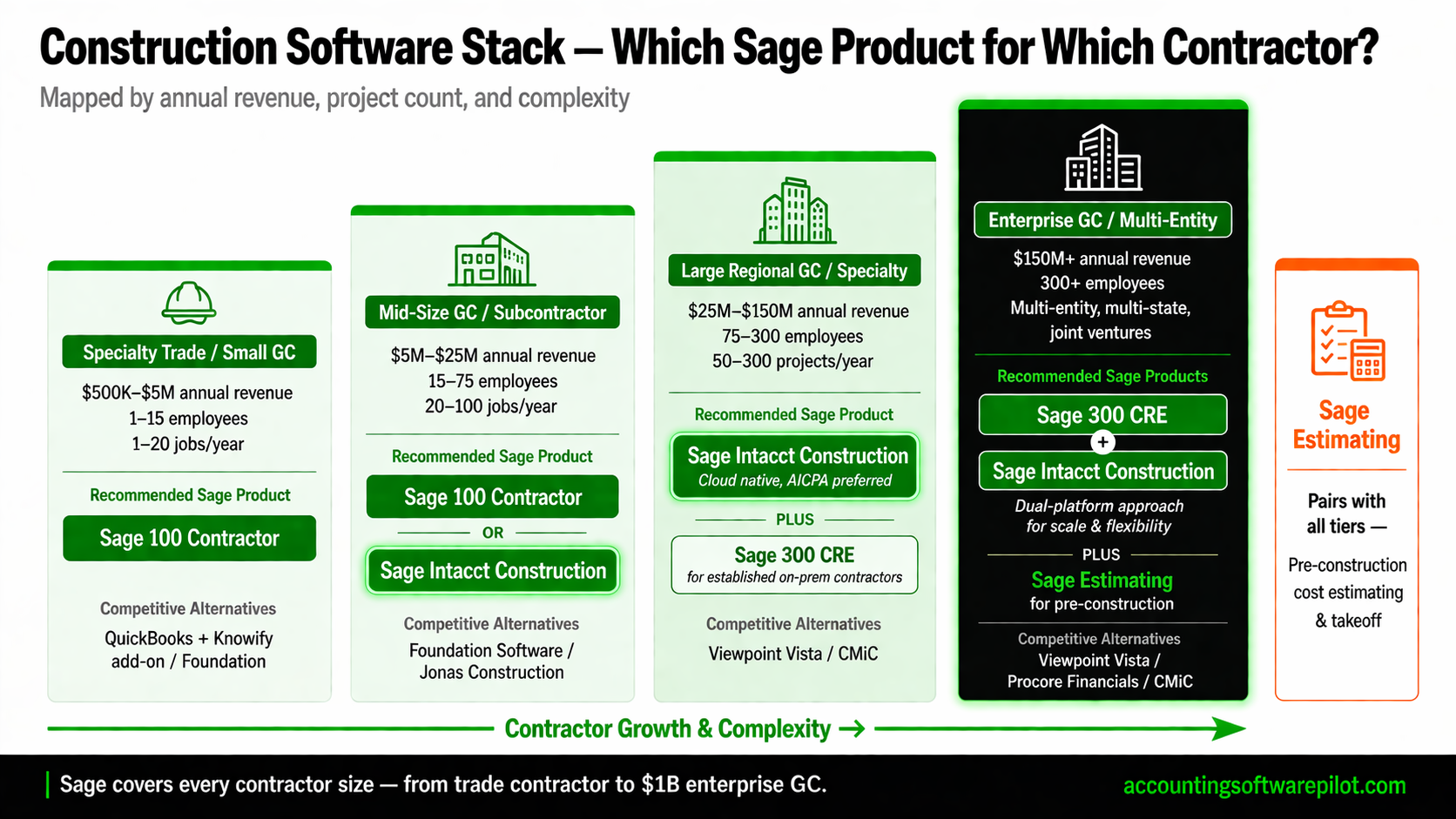
Sage 300 CRE Industry Standard | Commercial GCs, heavy civil, specialty contractors | On-prem / hosted | $25M–$500M revenue |
Sage 100 Contractor | Small to midsize GCs and specialty contractors | On-prem / hosted | $5M–$50M revenue |
Sage Intacct Construction | Cloud-native, multi-entity contractors | True cloud | $10M–$250M revenue |
Foundation Software | Self-performing contractors, union shops | On-prem / cloud | $5M–$150M revenue |
Procore (Financials) | Project management–centric firms | True cloud | $20M–$500M revenue |
QuickBooks + add-ons | Very small contractors, simple projects | Cloud | Under $5M revenue |
Construction-specific feature comparison
Feature | Sage 300 CRE | Sage 100 Contractor | Sage Intacct Construction | Foundation | Procore Fin. | QuickBooks |
|---|---|---|---|---|---|---|
Job costing | Deep | Deep | Deep | Deep | Strong | Basic (classes) |
Progress billing | Yes | Yes | Yes | Yes | Yes | Manual |
AIA G702/G703 billing | Native | Native | Native | Native | Native | Via add-on |
Retainage tracking | Native | Native | Native | Native | Native | Manual |
Certified payroll (WH-347) | Native | Native | Via partners | Native | Via integration | Via add-on |
Prevailing wage | Native | Native | Via partners | Native (union) | Via integration | No |
WIP reporting | Native | Native | Native | Native | Native | Manual Excel |
Change order mgmt | Native | Native | Native | Native | Native | No |
Subcontractor mgmt | Deep | Strong | Strong | Deep | Deep | No |
Lien waiver tracking | Native | Native | Native | Native | Native | No |
Equipment costing | Deep | Yes | Limited | Deep | Limited | No |
1. Sage 300 CRE — The industry standard
Sage 300 Construction and Real Estate (formerly Timberline) is the most deployed construction accounting system among US midsize and large commercial contractors. It's the product that defines the category, used across general contracting, heavy civil, specialty trade, and real estate developers for decades.
Sage 300 CRE covers the full stack: job cost, AP, AR, payroll, cash management, equipment, property management, service management, and project management. Its certified payroll and union payroll handling are industry-leading, and its equipment module supports true mobile-asset cost tracking for heavy civil contractors.
Pricing is custom and typically through Sage certified partners. Annual license + maintenance commonly runs $15K–$60K+ depending on users and modules, with implementation $20K–$100K+.
Sage 300 CRE verdict
Pick Sage 300 CRE if you're a commercial GC, heavy civil contractor, or specialty trade contractor in the $25M–$500M range with union, prevailing wage, and multi-project complexity. It's a heavier deployment than cloud-native tools, but the breadth is unmatched.
2. Sage 100 Contractor — Best for smaller GCs and specialty trades
Sage 100 Contractor is the younger sibling of Sage 300 CRE. It's aimed at smaller GCs, specialty contractors, and trade businesses — typically $5M–$50M in revenue. The feature set is narrower than 300 CRE but still covers job costing, progress billing, AIA forms, retainage, certified payroll, and change orders natively.
Sage 100 Contractor is often hosted via Sage-approved cloud hosting partners (ProjectWorks, Cetrom, Summit, etc.) so customers get remote access while keeping the product's desktop heritage intact.
Sage 100 Contractor verdict
Pick Sage 100 Contractor if you're a smaller GC or specialty contractor that needs full construction-grade accounting but doesn't yet need Sage 300 CRE's scale. Typical deployments run $8K–$25K/year.
3. Sage Intacct Construction — Best cloud-native construction financials
Sage Intacct Construction is the cloud-native member of Sage's construction family. Built on the same AICPA-preferred Sage Intacct platform, it combines Intacct's multi-dimensional GL, multi-entity consolidation, and real-time reporting with construction-specific modules for job costing, AP automation with POs, pay applications, and WIP.
It's increasingly the preferred choice for multi-entity construction holding companies, real estate developers, and project-driven contractors that want a true cloud platform rather than hosted desktop software. Certified payroll and prevailing wage are addressed via Sage partners (typically through specialized payroll providers).
Sage Intacct Construction verdict
Pick Sage Intacct Construction if you're a multi-entity contractor, developer, or project-driven firm that values cloud-native architecture and deep dimensional reporting more than union-grade payroll. Pair with a specialized payroll partner for prevailing wage.
4. Foundation Software — Best for self-performing contractors
Foundation Software (FOUNDATION) is the largest privately held construction accounting vendor in the US and a perennial competitor to Sage 300 CRE. Its strongest niche is self-performing contractors — firms with large field workforces, union agreements, and multi-state prevailing wage work.
Foundation's union and certified payroll module is widely regarded as the industry benchmark. It supports an enormous variety of union contracts, fringe calculations, and reciprocal agreements out of the box. The product is available on-prem or via Foundation's hosted cloud.
Foundation verdict
Pick Foundation if you're a self-performing contractor with heavy union, multi-state prevailing wage, or complex fringe calculations. It trades slightly on modernity of UI for unmatched payroll depth.
5. Procore Financials — Best when project management is the center
Procore began as construction project management and expanded into financials with Procore Financial Management (Project Financials + Invoice Management + Pay). For firms that have standardized on Procore for PM, having financials inside the same platform removes the integration tax of moving data between PM and accounting.
Procore Financials handles budgets, commitments, change management, subcontractor payments, pay apps, and compliance workflows. Most customers still pair Procore with a true GL — often Sage 300 CRE or Sage Intacct Construction — but Procore's financials suite reduces the hand-offs.
Procore verdict
Pick Procore Financials if Procore is already your PM platform of record and you want your project-to-billing workflow inside one system. For full GL, pair it with Sage Intacct Construction or Sage 300 CRE.
6. QuickBooks + construction add-ons — Best only for the smallest contractors
QuickBooks Online Plus or Desktop Contractor edition, combined with a construction add-on (Knowify, Buildertrend, Contractor Foreman, or Coins for certified payroll), can work for contractors under ~$5M revenue with simple project portfolios.
The ceiling is real: once you start doing prevailing wage, AIA billing at scale, or multi-entity reporting, the add-on stack gets expensive and brittle. Most contractors that try to stretch QuickBooks past $10M revenue describe the final 18 months as an administrative nightmare.
QuickBooks verdict
Pick QuickBooks + add-ons only if you're a very small contractor under $5M revenue with straightforward work. Plan your upgrade path to Sage 100 Contractor or Sage Intacct Construction before you outgrow it.
The 83-day problem: why construction accounting ROI is real
Industry data consistently shows US contractors wait roughly 83 days to collect — more than 2x the US average DSO across all industries. That gap is the single biggest driver of construction cash flow pain and is heavily driven by billing and compliance friction, not by customer willingness to pay.
Good construction accounting software attacks the 83-day problem directly:
AIA billing built right reduces GC/owner rejection rates by eliminating formatting issues
Lien waiver tracking prevents payment holds caused by missing compliance documents
Change order workflows turn verbal approvals into billable revenue faster
Real-time WIP reporting keeps bonding and line-of-credit relationships healthy, which in turn speeds payment
Accurate certified payroll prevents DOL and state agency holds on prevailing wage jobs
Even a 10-day reduction in DSO on $50M in annual revenue frees roughly $1.4M in working capital — often more than the total cost of the software over several years.
Pro tip: When evaluating construction accounting software, ask the vendor to walk through a full billing cycle: budget → commitment → pay app → lien waiver exchange → retainage release. If any step requires leaving the system or manually producing documents in Excel, that's where your margin will leak in real life.
How to choose the right construction accounting software
Define your revenue and project portfolio. Small trade sub under $5M? QuickBooks + add-ons may work. $5M–$50M? Sage 100 Contractor. $25M–$500M+? Sage 300 CRE, Foundation, or Sage Intacct Construction.
Identify prevailing wage and union exposure. Heavy exposure → Foundation or Sage 300 CRE. Light exposure → Sage Intacct Construction with a payroll partner.
Decide cloud-native vs on-prem/hosted. Cloud-native → Sage Intacct Construction or Procore. On-prem/hosted acceptable → Sage 300 CRE, Sage 100 Contractor, Foundation.
Consider your PM platform. Already on Procore? Strongly consider Procore Financials, usually paired with a GL.
Plan multi-entity and acquisition strategy. Multi-entity holdings → Sage Intacct Construction scales best.
Final verdict
Construction accounting is a category where the generic cloud winners (QuickBooks, Xero) stop being good answers very quickly. The right software pays for itself by accelerating cash flow, tightening job margins, and keeping compliance agencies off your back. Sage's construction lineup — 300 CRE, 100 Contractor, and Sage Intacct Construction — covers more of the US contractor market than any other vendor and is the default starting shortlist for most buyers, alongside Foundation Software and Procore.
Overall: For US commercial contractors, Industry Standard Sage 300 CRE remains the safest pick for $25M+ firms; Sage 100 Contractor is the right step before 300 CRE; Sage Intacct Construction is the cloud-native graduation path; and Foundation Software is the right answer for union-heavy self-performers. Whichever you pick, insist on native AIA, certified payroll, retainage, WIP, and change order workflows — they are not optional in this industry.
This article is for informational purposes only and does not constitute financial, accounting, legal, or compliance advice. Industry statistics on collection time and working capital loss are drawn from publicly reported research by industry associations and construction payments providers and are subject to change. Pricing, features, and product availability are based on public sources at the time of writing. All trademarks — including Sage 300 CRE, Sage 100 Contractor, Sage Intacct, Foundation Software, Procore, and QuickBooks — are the property of their respective owners. Verify pricing and compliance capabilities directly with each vendor before purchasing.

