

Nonprofit accounting isn't regular accounting with a different logo — it's a distinct discipline built around fund accounting, grant compliance, and donor stewardship. This guide ranks the best US nonprofit accounting software for 2026, with deep coverage of Sage Intacct, QuickBooks Online, Blackbaud Financial Edge NXT, Aplos, Fund EZ, and Xero.
The United States is home to more than 1.5 million registered nonprofits, ranging from all-volunteer community groups to $1B+ global NGOs. Yet the overwhelming majority still use software that was never designed for fund accounting, restricted-net-asset tracking, or grant reporting. The cost of that mismatch shows up every audit season in reclassification entries, 990 preparation headaches, and board dashboards that don't answer the right questions.
The good news: there's now a clear tier of nonprofit-ready platforms at every budget level. The goal of this guide is to match your organization's size and complexity to the right tool — without overspending on capability you won't use or outgrowing a platform in two years.
Bottom line up front: Sage Intacct is the clear leader for mid-to-large US nonprofits and is the only accounting product formally preferred by the AICPA. Blackbaud Financial Edge NXT is a purpose-built alternative for those already in the Blackbaud fundraising ecosystem. QuickBooks Online and Xero work for small nonprofits with simple needs. Aplos and Fund EZ fill the low-cost fund-accounting niche for small-to-mid organizations.
What makes nonprofit accounting different
Commercial accounting tracks revenue, expenses, and profit. Nonprofit accounting tracks how money was received, how it's restricted, and how it was spent toward mission. That fundamental difference drives several requirements commercial software rarely handles well:
Fund accounting: Separate accounting by fund (general operating, building, endowment, program-specific), with each fund maintaining its own balance.
Restricted vs. unrestricted net assets: FASB ASC 958 requires tracking donor-restricted versus unrestricted net assets, plus the release of restrictions over time.
Grant tracking and reporting: Budget-to-actual reporting by grant, with indirect cost allocation and grant-specific reporting calendars.
Program-based reporting: Expenses allocated across programs, management & general, and fundraising for Form 990 Statement of Functional Expenses.
Form 990 preparation: Functional expense categorization and supporting schedules required by IRS filings.
Donor management integration: Seamless flow of gift data from CRM to GL without manual re-keying.
Board and funder reporting: Custom dashboards for directors and funder-specific financial reports.
Running those processes inside commercial software usually means a tangle of classes, subclasses, and workarounds. Purpose-built nonprofit systems handle them as first-class concepts.

The 2026 shortlist at a glance
Platform | Best for | Starting price (USD) | Fund accounting depth |
|---|---|---|---|
Sage Intacct AICPA Preferred | Mid-to-large nonprofits, multi-entity, complex grants | ~$15,000–$50,000+/yr | Deep — native fund accounting |
Blackbaud Financial Edge NXT | Foundations, large nonprofits in Blackbaud ecosystem | ~$10,000–$40,000+/yr | Deep — purpose-built |
QuickBooks Online + nonprofit add-ons | Small nonprofits under $2M budget | $35–$235/mo | Basic — uses classes/locations |
Aplos | Small churches, small nonprofits | $79–$179/mo | Good — native fund accounting |
Fund EZ | Small-to-mid nonprofits wanting on-premise fund accounting | ~$1,500+/user/yr | Good — purpose-built fund accounting |
Xero | Small nonprofits, global missions | $20–$80/mo | Basic — uses tracking categories |
1. Sage Intacct — best overall for US nonprofits
Sage Intacct has, over the past decade, established itself as the dominant cloud financial management platform for US nonprofits with budgets above roughly $3M. It is the only accounting product formally preferred by the AICPA, and its nonprofit customer base includes associations, foundations, higher-ed affiliates, health systems, social services organizations, and international NGOs.
What makes Sage Intacct fit nonprofits so well is its multi-dimensional general ledger. Rather than jamming grant, fund, program, department, and location into a bloated chart of accounts, Intacct lets you code every transaction across up to eight dimensions simultaneously. That means one clean GL, and any report you need — by grant, by program, by funder, by location — is a filter away.
Sage Intacct nonprofit capabilities
Native fund accounting with restricted/unrestricted net asset tracking and automated release of restriction
Grant lifecycle management — budgeting, tracking, indirect cost allocation, and funder-specific reporting
Multi-entity consolidation across chapters, affiliates, or international entities with automated intercompany eliminations
Outcome measurement linking financial data to program outcomes and KPIs
Board-ready dashboards with real-time financial position, program ratios, and liquidity analysis
Form 990 Statement of Functional Expenses generated natively
Integrations with Salesforce NPSP, Blackbaud Raiser's Edge NXT, Bloomerang, Virtuous, ADP, and Paylocity
Note: Sage Intacct pricing is quote-based and varies significantly by organization size, module mix, and user count. Industry sources place typical first-year costs for a mid-size nonprofit (10–25 users, core financials + grants + multi-entity) in the $25,000–$50,000 range, plus implementation. Always request a custom quote.
Where Sage Intacct is less suitable
Intacct is overkill — and over-budget — for organizations with operating budgets under $2M, single-entity structures, and no active grant portfolio. For those nonprofits, QuickBooks Online with nonprofit add-ons or Aplos is a better fit.
2. Blackbaud Financial Edge NXT — purpose-built for foundations and large nonprofits
Financial Edge NXT is Blackbaud's flagship accounting product for nonprofits. It's a true fund accounting system built on decades of domain experience, and it integrates natively with Blackbaud's fundraising products — Raiser's Edge NXT, Luminate Online, and Blackbaud CRM.
For foundations, private schools, faith-based organizations, and large social-service nonprofits already invested in the Blackbaud ecosystem, Financial Edge NXT is often the natural choice. Its grant tracking, restricted fund handling, and IRS reporting workflows are all strong.
Drawbacks: implementation is complex and costly, the user interface — while modernized from the legacy Financial Edge 7 — still feels heavier than Intacct's, and pricing is typically in the same mid-five-figures range as Intacct. Organizations without the Blackbaud fundraising side often find Intacct's broader integration ecosystem more appealing.
3. QuickBooks Online — affordable but requires workarounds
QuickBooks Online (QBO) isn't a fund accounting system, but it's what the majority of US nonprofits under $2M in budget actually use. Through QBO's "Nonprofit" tier (effectively QBO Plus with customized chart of accounts and reports), organizations can approximate fund accounting using classes and locations.
Pricing runs from $35/month (Simple Start) to $235/month (Advanced), with most nonprofits landing on Plus ($99/month) or Advanced. QBO integrates with donor platforms like Kindful, DonorPerfect, and Bloomerang, and with payroll via QuickBooks Payroll or Gusto.
The trade-offs are real: true restricted-net-asset accounting requires manual journal entries, grant budget-to-actual reports are clunky, and the Statement of Functional Expenses typically needs to be built in Excel from exported data. For organizations that have outgrown the "one bookkeeper and a spreadsheet" stage, QBO starts to feel constrained quickly.
4. Aplos — best for churches and small nonprofits
Aplos is a cloud accounting platform built specifically for nonprofits and churches, with native fund accounting, donation tracking, and Form 990 preparation all included in the base product. At $79/month (Lite) to $179/month (Advanced), it's a genuine mid-point between QBO and enterprise fund accounting systems.
Aplos shines for small-to-mid organizations that want purpose-built functionality without enterprise pricing: churches with tithe management needs, small charities with 2–10 active restricted funds, and startup nonprofits preparing for their first audit. Its donation management and contribution-statement generation are particularly strong for faith-based organizations.
5. Fund EZ — on-premise fund accounting
Fund EZ has been a quiet workhorse in the nonprofit accounting space for more than 30 years. It's an on-premise (with hosted options) fund accounting system that handles grants, budgets, restricted funds, and functional expense reporting without the cost of enterprise platforms. For nonprofits in the $1M–$10M budget range that want deeper fund accounting than QBO but can't justify Intacct's price tag, Fund EZ is worth evaluating.
6. Xero — global-friendly small nonprofit option
Xero's strengths for US nonprofits are its clean interface, strong bank reconciliation, and solid international handling. Tracking categories substitute for fund accounting, similar to QBO classes. It's a better fit than QBO for nonprofits operating across borders or working with overseas grantees, but has a smaller US nonprofit ecosystem than QBO.
Key features nonprofit accounting software should include
Capability | Sage Intacct | Blackbaud FE NXT | QBO | Aplos |
|---|---|---|---|---|
Native fund accounting | Yes | Yes | Via classes | Yes |
Grant tracking & reporting | Deep | Deep | Basic | Good |
FASB ASC 958 compliance | Automated | Automated | Manual | Automated |
Multi-entity consolidation | Native | Add-on | Not supported | Limited |
Form 990 functional expenses | Native | Native | Export to Excel | Native |
Donor mgmt integration | Broad ecosystem | Native (Raiser's Edge) | Some connectors | Built-in |
Board-ready dashboards | Excellent | Good | Basic | Basic |
Audit trail & internal controls | SOC 1/SOC 2 | SOC 1/SOC 2 | Basic | Good |
How to choose the right platform
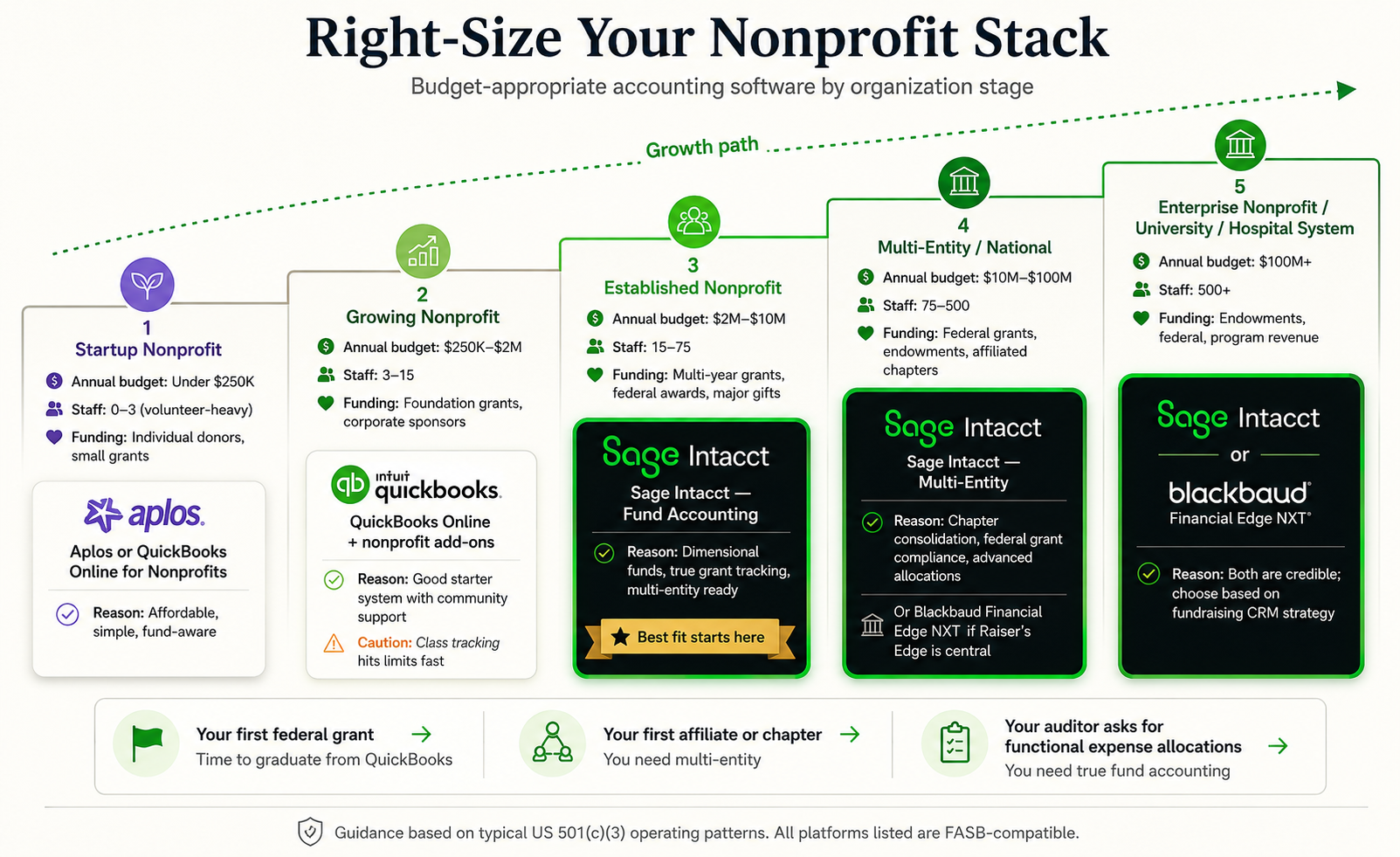
Size and complexity drive the decision more than any other factor. Use these rough breakpoints:
Under $500K annual budget, 1–2 staff: QuickBooks Online Plus with nonprofit chart of accounts, or Aplos Lite.
$500K–$2M, 3–10 staff, a few restricted funds: Aplos Advanced, Fund EZ, or QBO Advanced with add-ons.
$2M–$10M, 10+ staff, active grant portfolio: Sage Intacct or Blackbaud Financial Edge NXT.
$10M+, multi-entity, federal grants: Sage Intacct (most common), or Blackbaud for ecosystem alignment.
Pro tip: Don't choose software based on today's size — choose based on where you'll be in 3 years. Migrating accounting systems mid-growth is painful: data conversion, chart-of-accounts mapping, re-implementation, and user retraining typically cost $25,000–$100,000 and take 3–6 months. A platform you'll keep for 7–10 years is always cheaper than switching every 3.
Integration with donor management and CRM
The single biggest inefficiency in nonprofit finance operations is re-keying donor data between a fundraising CRM and the GL. Any platform you choose should have a clean, well-maintained integration with your donor database:
Salesforce NPSP — Integrates with Sage Intacct (Salesforce Connector), Blackbaud FE NXT, and others.
Blackbaud Raiser's Edge NXT — Native to Financial Edge NXT; also has a Sage Intacct connector.
Bloomerang, Virtuous, DonorPerfect, Kindful — Pre-built connectors to Sage Intacct, QBO, and Xero.
Budget time during implementation to design this integration carefully — which fields sync, how gift batches flow to GL, how pledge aging is handled, and how refunds are reversed on both sides.
Common pitfalls nonprofits run into
Common pitfalls to avoid:
Overloading classes in QBO: Teams often stack fund, program, grant, and department into QBO classes. It works until audit season exposes the sprawl. Move to fund accounting before complexity breaks your reporting.
Under-budgeting for implementation: Software cost is often only 40–60% of first-year spend. Implementation, data migration, training, and integration typically add as much or more.
Skipping segregation of duties: Even small nonprofits need separate users for entry vs. approval. Build this into your permissions structure from day one.
Ignoring integration with payroll: Salary and benefits are often 60–70% of nonprofit expenses. Payroll must integrate cleanly, with full functional expense allocation.
Final recommendations by scenario
Sage Intacct wins for mid-to-large nonprofits with complex needs
AICPA-preferred, deep FASB compliance, and strong audit trail
Multi-dimensional GL handles fund, grant, program, and location cleanly
Best-in-class multi-entity consolidation for chapters or affiliates
Broadest integration ecosystem with nonprofit CRMs
Blackbaud Financial Edge NXT wins for Blackbaud-ecosystem organizations
Native integration with Raiser's Edge NXT and Luminate Online
Purpose-built fund accounting with decades of nonprofit experience
Strong fit for foundations, private K-12, and faith-based organizations
QuickBooks Online or Aplos wins for small nonprofits
Low monthly cost, no implementation partner needed
QBO has the largest third-party ecosystem in the US
Aplos offers true fund accounting at SMB pricing — ideal for churches and small charities
Overall: For US nonprofits with meaningful grant activity, restricted funds, or multi-entity structures, Sage Intacct remains the benchmark — and its AICPA preference is not marketing, it's recognition of genuine fit for the sector. Smaller organizations can start with QuickBooks Online or Aplos and graduate to Intacct as complexity grows. Whichever platform you pick, match it to your 3-year trajectory, not just this year's budget.
This article is provided for informational purposes only and does not constitute accounting, audit, tax, or legal advice. Pricing, features, and AICPA preferences referenced are based on publicly available information as of 2026 and may change. All product names — including Sage, Sage Intacct, Blackbaud, Financial Edge NXT, QuickBooks, Aplos, Fund EZ, and Xero — are trademarks of their respective owners and are used here for identification purposes only. Nonprofits should consult a qualified CPA with nonprofit experience before making accounting platform decisions.

