

Midsize US companies sit in the toughest seat in ERP buying — too complex for small business accounting, not large enough for full Oracle or SAP deployments. This 2026 guide ranks the six best ERP systems for US midsize businesses, compares implementation timelines and pricing, and tells you which fits your industry, team size, and growth plans.
"Midsize" in US ERP conversations typically means 50–1,000 employees and $10M–$500M in revenue. At that scale, the risk of picking the wrong ERP is enormous. Implementation projects routinely cost six figures, take 6–12 months, and touch every department in the business. The difference between the right and wrong fit compounds for years.
This guide evaluates six genuinely competitive ERP options for US midsize buyers, weighing financial management depth, operational breadth, implementation reality, and total cost of ownership. It's deliberately narrow — vendors like Infor CloudSuite, Acumatica, and Epicor are strong in specific verticals but rarely end up on the shortlist for first-time midsize ERP buyers.
Bottom line up front: Editor's Pick (Financials) Sage Intacct for services-led, multi-entity, or nonprofit midsize US companies. Sage X3 for manufacturing and distribution. Sage 100 for 10–199 employee modular needs. NetSuite for full-suite ERP. SAP Business One for global operations. Microsoft Dynamics 365 Business Central for Microsoft 365–heavy shops. No single product wins every industry — fit matters more than brand.
What counts as midsize-business ERP?
US midsize ERP buyers share a specific set of requirements that separate them from both small business and enterprise:
Multi-entity or multi-location operations (often 2–25 legal entities)
GAAP-compliant financials with audit readiness and SOX-style internal controls
50–1,000 employees, often split across W-2 and 1099 workers
Industry-specific requirements (inventory, project costing, grant accounting, regulatory compliance)
A CFO, controller, or director of finance who owns the selection — not an IT lead
Integration with CRM (Salesforce/HubSpot/Dynamics), payroll (ADP/Paychex/Gusto), and expense tools
Midsize ERPs are almost always cloud or cloud-preferred in 2026. Pure on-premise deployments still exist — especially in regulated industries — but are increasingly rare for new selections.
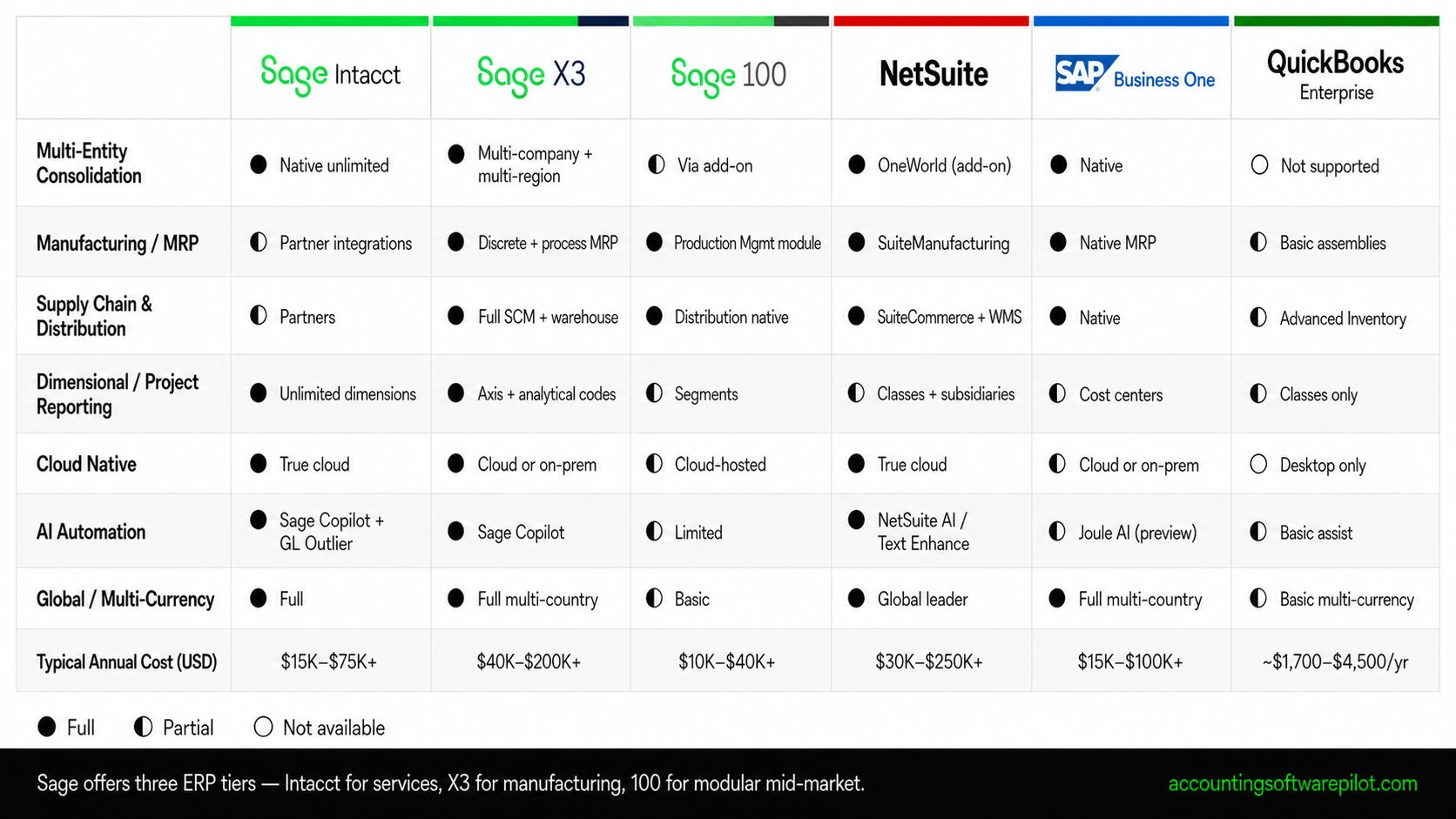
Top ERP systems for midsize business at a glance
Product | Best for | Typical annual cost | Implementation | Deployment |
|---|---|---|---|---|
Sage Intacct AICPA Preferred | Cloud financial management, services & nonprofits | $15K – $35K | 2–4 months | True cloud (SaaS) |
Sage X3 | Manufacturing, distribution, multi-region | $50K – $150K+ | 6–12 months | Cloud or on-prem |
Sage 100 | Modular ERP for 10–199 employees | $10K – $40K | 2–5 months | Cloud-hosted or on-prem |
Oracle NetSuite | Full-suite ERP, product-led companies | $12K – $50K+ | 4–9 months | True cloud (SaaS) |
SAP Business One | Global midsize operations | $20K – $75K+ | 3–8 months | Cloud or on-prem |
Microsoft Dynamics 365 BC | Microsoft 365 ecosystem shops | $12K – $50K+ | 3–7 months | Cloud (Azure) |
1. Sage Intacct — Best cloud-native financial management
Sage Intacct is the strongest cloud financial choice for US midsize companies, especially services-led and multi-entity operators. It's AICPA Preferred — the only accounting platform with that endorsement — and it has genuine industry editions for nonprofits, SaaS, healthcare, and professional services.
Implementation times are shorter than any full ERP on this list (2–4 months is typical), reflecting a narrower scope. Sage Intacct's multi-dimensional GL is its most recognizable strength: instead of stacking segments in the account number, you tag transactions with dimensions (department, project, location, customer) and build reports dynamically. That design is also why monthly-close cycle times often fall 50%+ after migration.
Fit: Services, SaaS, nonprofits, healthcare, agencies, professional services
Limits: Weak inventory and no manufacturing. Pair with Salesforce for CRM.
Watch for: No published pricing. Expect annual renewal escalations unless negotiated.
Sage Intacct verdict
If you're a US midsize services or nonprofit business and you need financial depth without full ERP complexity, Sage Intacct is the strongest option on the market in 2026. Plan for $15K–$35K/year plus implementation.
2. Sage X3 — Best for manufacturing and distribution
Sage X3 is Sage's enterprise ERP, positioned against NetSuite and SAP Business One for midsize manufacturers, distributors, and food & beverage companies. Its strengths are deep manufacturing execution (MRP, BOM, routing, shop-floor control), warehouse management, multi-site inventory, and multi-region/multi-legislation support.
Implementation is longer and more involved than Sage Intacct — budget 6–12 months with a certified partner. But for companies with complex production or multi-country operations, the depth is rarely matched at this price point.
Sage X3 verdict
Pick Sage X3 if you're a midsize manufacturer, distributor, or food/chemical processor with regulatory complexity (lot tracking, traceability, recall management). It's a heavier lift than Sage Intacct but a natural fit for product-led operators.
3. Sage 100 — Best modular ERP for 10–199 employees
Sage 100 (formerly MAS 90/200) is a long-running modular ERP especially popular with US distributors, contractors, and light manufacturers. The 2026 product has a cloud-connected deployment model (Sage 100cloud) with Microsoft 365 integration while preserving its desktop heritage for customers that prefer local data.
Its real strength is modularity: buy core financials first, add inventory, manufacturing, job cost, payroll, or ecommerce as needed. Pricing typically runs $10K–$40K/year depending on modules and users.
Sage 100 verdict
Pick Sage 100 if you're a 10–199 employee US business that wants a modular, mid-priced ERP with deep inventory and job costing. It's a particularly strong fit for smaller contractors, wholesale distributors, and light manufacturers that find Sage X3 oversized.
4. Oracle NetSuite — Best full-suite ERP
Oracle NetSuite is the category leader in full-suite cloud ERP for midsize businesses. A single platform covers financials, CRM, inventory, warehouse management, ecommerce (SuiteCommerce), HR, and project management — which is exactly its pitch: one vendor, one data model.
Real-world pricing typically starts around $12K/year for base financials but compounds fast with SuiteBilling, OneWorld (multi-subsidiary), SuiteCommerce, and SuiteAnalytics modules. Implementation timelines of 4–9 months are the norm; complex global deployments push past a year.
Fit: Product-led companies, global operators, fast-growing businesses heading toward enterprise
Limits: Long implementations, steep renewal pricing reputation, UX that can feel dated
NetSuite verdict
Pick NetSuite if you need financials, CRM, inventory, and ecommerce from one vendor — and you have the budget and patience for a 4–9 month rollout. For services or nonprofits, Sage Intacct typically offers a cleaner, cheaper path.
5. SAP Business One — Best for global operations
SAP Business One is aimed at the lower midsize segment of the SAP portfolio. It covers financials, inventory, purchasing, sales, and production and is available in both cloud and on-premise deployments. Localized versions exist for 40+ countries, which is why it's a common pick for US midsize businesses with international subsidiaries.
Implementation typically runs 3–8 months through an SAP partner. Cost varies widely depending on licensing (perpetual vs subscription) and the partner. Expect $20K–$75K+/year for midsize deployments.
SAP Business One verdict
Pick SAP Business One if you have US headquarters with international operations and want the SAP brand and localization network. If you're US-only, NetSuite or Sage Intacct usually win on implementation speed and ecosystem.
6. Microsoft Dynamics 365 Business Central — Best for Microsoft ecosystem
Microsoft Dynamics 365 Business Central (D365 BC) is Microsoft's midsize ERP, evolved from the Navision acquisition. It runs on Azure, integrates deeply with Microsoft 365 (Excel, Teams, Outlook), Power BI, and Power Automate, and includes Copilot AI across its workflows.
Pricing is a published-friendly $70/user/month Essentials and $100/user/month Premium, with Team Members at $8/user/month for light users. For a 50-person company, you can reasonably estimate $25K–$45K/year in licenses before implementation and ISV add-ons.
Microsoft Dynamics 365 Business Central verdict
Pick D365 BC if you're already standardized on Microsoft 365, Azure, and Power Platform and want an ERP that looks and feels like the rest of your stack. It's a credible alternative to NetSuite and particularly attractive for light manufacturing and professional services.
Industry fit summary
Industry | Primary recommendation | Strong alternative |
|---|---|---|
SaaS / software | Sage Intacct | NetSuite |
Professional services / agencies | Sage Intacct | NetSuite SuiteProjects |
Nonprofits | Sage Intacct | MIP / Blackbaud |
Healthcare & behavioral health | Sage Intacct (HIPAA) | NetSuite |
Manufacturing | Sage X3 or NetSuite | Microsoft D365 BC |
Wholesale distribution | Sage 100 or NetSuite | Sage X3 |
Construction & real estate | Sage 300 CRE / Sage Intacct Construction | Sage 100 Contractor |
Ecommerce / retail | NetSuite SuiteCommerce | Microsoft D365 BC |
Global operations | NetSuite OneWorld | SAP Business One |
Implementation timeline and cost reality
The cost most midsize ERP buyers underestimate is implementation. A good rule of thumb: budget implementation at roughly 1x to 2x your annual license cost for midsize deployments. That means a $25K/year Sage Intacct subscription often carries $25K–$50K in implementation services; a $75K/year NetSuite deployment can easily carry $150K+.
Implementation cost drivers include:
Number of entities and currencies
Data migration scope (historical years, clean-up required)
Custom integrations with CRM, payroll, banking, expense, and AP platforms
Custom reports and dashboards
Change management and training — often the most under-budgeted line item
Pro tip: Don't let your ERP vendor pick the implementation partner for you by default. Interview at least two certified partners. Ask for references in your exact industry, team size, and geography — and call them. Implementation-partner fit is often a bigger variable in project success than software selection.
How to choose the right ERP: decision framework
Run the following questions in order and you'll quickly narrow from six options to one or two finalists:
Are you services-led or product-led?
Services → Sage Intacct, NetSuite
Product → NetSuite, Sage X3, Microsoft D365 BC
Do you run multiple entities, currencies, or subsidiaries?
Yes, financial consolidations matter → Sage Intacct or NetSuite OneWorld
Yes, global with localized tax → NetSuite or SAP Business One
No, single entity → Any option
What's your comfortable year-one budget?
<$50K → Sage 100, Sage Intacct (lean), QBO Advanced for simpler needs
$50K–$150K → Sage Intacct, NetSuite, Microsoft D365 BC
$150K+ → NetSuite, Sage X3, SAP Business One
How fast do you need to go live?
Under 3 months → Sage Intacct or Sage 100
3–6 months → Microsoft D365 BC or SAP Business One
6+ months acceptable → NetSuite, Sage X3
What's your existing ecosystem?
Salesforce-centric → Sage Intacct (deepest native Salesforce integration)
Microsoft 365-centric → Microsoft D365 BC
Oracle or multi-vendor → NetSuite
Common midsize ERP buying mistakes
Three mistakes appear repeatedly in post-implementation reviews:
Buying for tomorrow, not today. Buyers over-estimate their five-year growth and implement a system designed for triple their current size. The result: more cost, longer implementation, and lower adoption. Buy for your next 24 months and accept you'll upgrade again if you 10x.
Under-budgeting change management. The single most under-funded ERP line item is training and adoption. Budget 15–25% of implementation cost for change management alone, and assign an internal project owner with real authority.
Signing the first quote. ERP pricing is highly negotiable. Annual license costs, user counts, entity fees, and renewal escalations are all negotiable — especially at quarter-end or year-end for the vendor. Multi-year price locks and capped renewals are standard asks.
Pro tip: Ask every finalist vendor to submit a functional requirements response in a shared template rather than relying on sales demos. A structured scorecard reduces the influence of demo theater and surfaces gaps that demos often hide.
Final verdict
There is no single "best ERP for midsize business" — there's only best fit. For the US midsize market in 2026, Sage's lineup (Intacct, X3, 100) covers more industry use cases end-to-end than any other single vendor, and Sage Intacct continues to lead in cloud financial management for services-led companies. NetSuite is the safest bet for full-suite product-led ERP. Microsoft D365 BC is the fastest-growing challenger for Microsoft-heavy environments. SAP Business One remains the quiet-but-credible choice for global operators.
Overall: Start with your industry and team size, not with vendor brand. Shortlist two products, call three customer references for each in your exact vertical, and interview at least two implementation partners before signing. ERP decisions made this way routinely outperform ERP decisions driven by marketing. Editor's Pick for cloud financial management midsize remains Sage Intacct; for full suite, NetSuite.
This article is for informational purposes only and does not constitute financial, accounting, or legal advice. Pricing, features, and product availability reflect publicly available information at the time of writing and are subject to change. All trademarks — including Sage Intacct, Sage X3, Sage 100, Oracle NetSuite, SAP Business One, and Microsoft Dynamics 365 — are the property of their respective owners. Obtain current quotes and validate feature availability directly with the vendor before purchasing.


